Built and documented the Java client/server architecture with multithreading, TCP communication, and a Swing-based client interface.
Secure Java Chat Application with SSL/TLS
Java client/server chat application with TCP sockets, SSL/TLS, certificate validation, MySQL message storage, Swing UI, and Wireshark-based security tests.
Key highlights
- Implemented a concrete client/server security project instead of staying at theory level.
- Validated the effect of SSL/TLS by comparing readable traffic without encryption and unreadable payloads when encryption was enabled.
- Connected Java networking, certificate handling, database storage, GUI interaction, and test reporting in one project.
ContextBUT R&T S3 secure development project
Core featureMulti-user chat with accounts, message history, and GUI client
Security proofWireshark comparison with SSL disabled/enabled and invalid-certificate rejection
Evidence availableTechnical documentation, user guide, test report, source code, and generated Javadoc
What I handled
Configured SSL/TLS using Java secure sockets, keystores, truststores, and certificate validation behavior.
Integrated MySQL storage for users and timestamped messages, including a /history command to retrieve previous exchanges.
Produced technical documentation, a user guide, and a test report covering clear-text communication, invalid certificate handling, encryption validation, and message storage.
Results & evidence
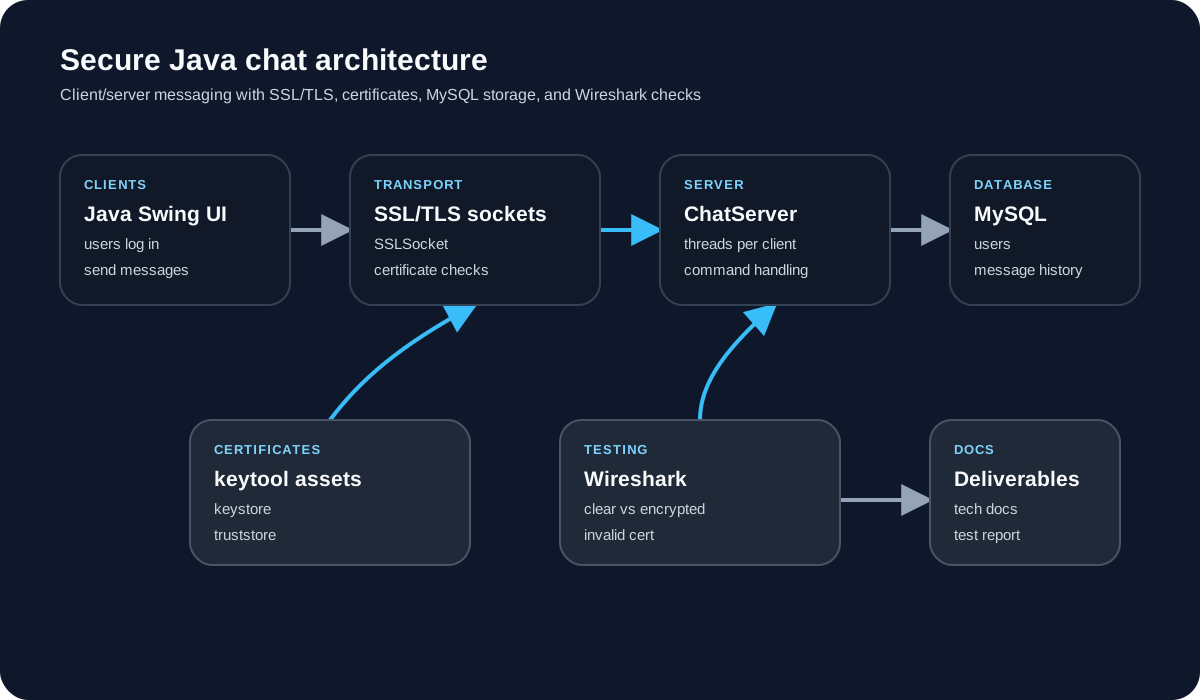
Secure chat architecture
Timeline
Build the chat architecture
Create the Java client/server base with TCP communication, multithreading, user handling, and a Swing interface.
Add security and storage
Enable SSL/TLS, configure keystores/truststores, validate certificates, and persist messages in MySQL.
Test and document
Compare clear and encrypted captures with Wireshark, test invalid certificates, validate message history, and produce final documentation.
Overview
This project is a secure Java chat application built as a client/server system. It combines networking, security, database storage, and graphical interaction in one practical project.
The goal was to build a real messaging application and then prove that the security controls were doing something observable. That is why the project includes not only code, but also a technical documentation file, a user guide, and a test report.
Context
The project was developed in a BUT R&T S3 environment around secure application development. The application allows users to exchange messages through a server, while SSL/TLS protects the communication path and MySQL stores user and message data.
The important point is that the security part was tested, not only described.
What I built
The project includes:
- a Java chat server
- Java clients using a Swing graphical interface
- TCP client/server communication
- multithreaded client handling
- SSL/TLS secure sockets
- keystore and truststore configuration
- MySQL storage for users and messages
- message history retrieval through
/history - Wireshark validation with SSL disabled and enabled
Architecture / approach
The architecture is simple but useful:
- the client opens a connection to the server
- the server handles multiple clients with dedicated threads
- SSL/TLS secures the client/server exchange
- certificates are validated through the truststore logic
- MySQL stores users and timestamped messages
- the client interface lets users chat and retrieve history
- Wireshark is used to check what appears on the network
This is exactly the kind of project that shows the difference between “I know the word encryption” and “I tested what encryption changes in a real capture”.
Security tests
The test report covers several useful scenarios:
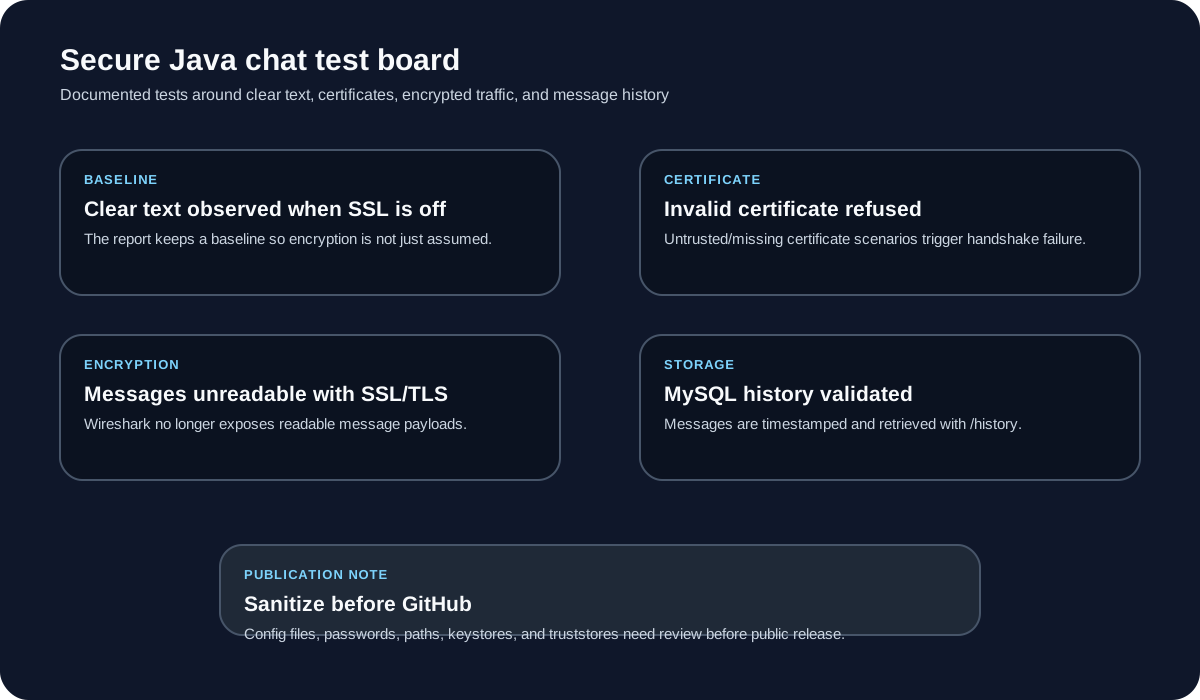
Clear-text baseline
SSL/TLS was disabled to observe the baseline behavior. This made it possible to see that messages could be readable in traffic captures when communication is not protected.
Invalid certificate rejection
The client/server connection was tested with an invalid or missing certificate scenario. The expected and observed behavior was connection refusal, with an SSL handshake error.
Encrypted traffic validation
With SSL/TLS enabled, Wireshark captures no longer showed readable message content. This confirmed the practical effect of the secure transport layer.
Message storage and history
MySQL storage was tested by sending messages, validating database persistence, and retrieving previous exchanges through the /history command.
Proof available
The uploaded project material includes:
- source code
- generated Java documentation
- technical documentation
- user guide
- test report
Before publishing the source publicly, configuration files should be reviewed and sanitized so no local paths, passwords, keystores, truststores, or environment-specific values are exposed.
Results
This project demonstrates a useful mix of skills:
- Java client/server development
- secure socket programming
- certificate validation logic
- database persistence
- GUI development
- Wireshark-based verification
- structured test documentation
Limits and improvements
The application is a learning project, not a production messaging platform. The main improvements would be:
- stronger password handling
- cleaner configuration management
- better error handling in the UI
- sanitized public repository structure
- stronger certificate lifecycle management
- automated tests around authentication and message storage
What this project demonstrates
This project is valuable because it connects security theory with proof. It shows that I can implement a feature, test it, observe it with tools, and explain what the result means technically.
Test evidence board